Key Takeaways
- PRP contains concentrated platelets but may also include varying amounts of white and red blood cells.
- White blood cells can support immune and healing responses, but their concentration may influence inflammation.
- Red blood cells are generally reduced during PRP preparation because their breakdown can affect the treatment environment.
Introduction
Platelet-rich plasma (PRP) therapy is often described as a treatment that uses your own blood to support the body’s natural healing process. But PRP is more than just concentrated platelets. Depending on how it is prepared, it can also contain different amounts of white blood cells (WBCs) and red blood cells (RBCs). Understanding these components can make the treatment easier to understand and explain why not every PRP preparation is the same.
What Is PRP?
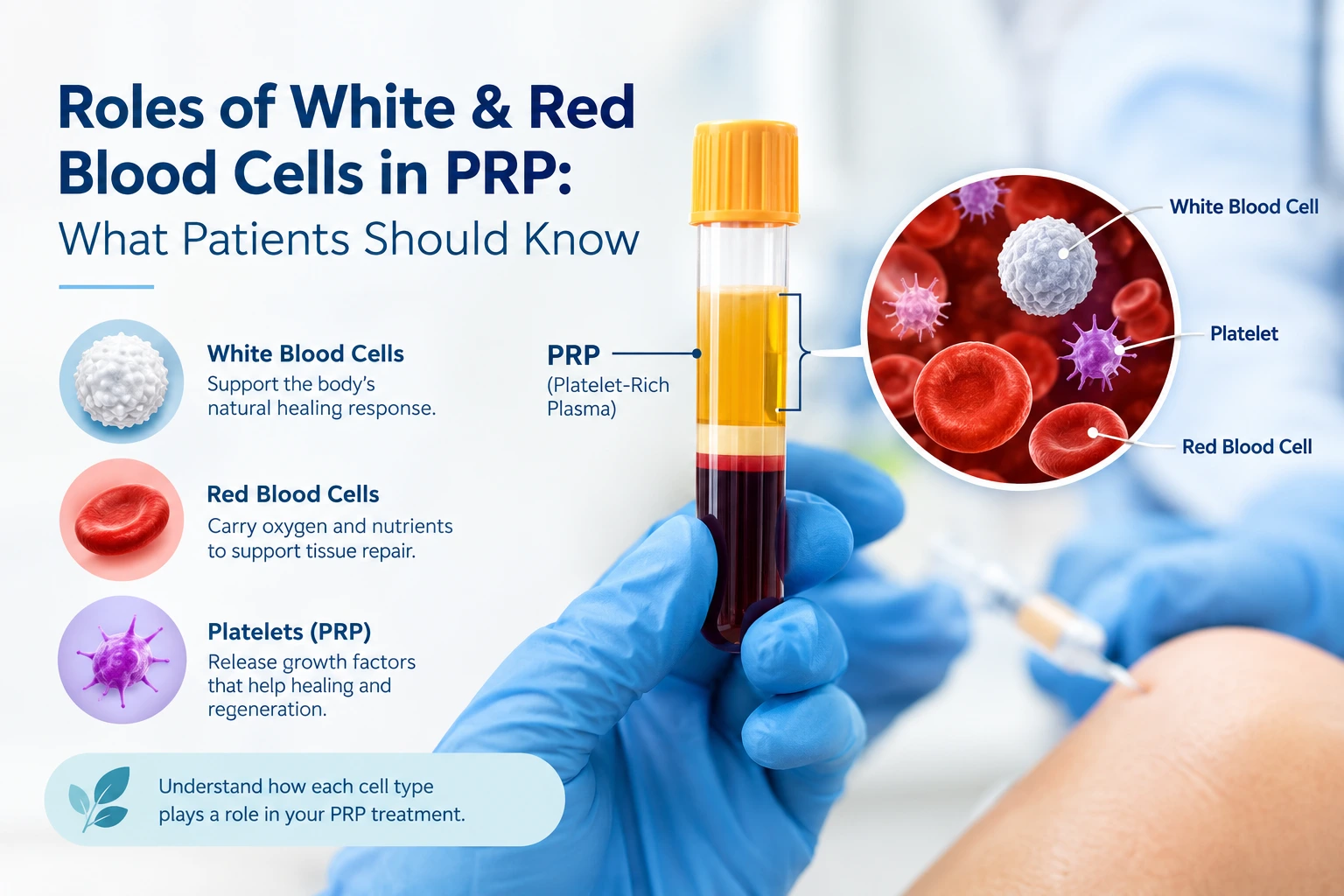
PRP is prepared by drawing a small amount of your blood and processing it to create a plasma product with a higher platelet concentration than whole blood. Platelets release signaling molecules and growth factors involved in tissue repair. The final PRP preparation can also contain varying levels of leukocytes and erythrocytes, depending on the processing method.
This matters because PRP composition may influence how it interacts with injured tissue. Research continues to examine which PRP composition best suits different conditions.
The Role of White Blood Cells in PRP
- White blood cells support the body’s natural healing response in the injured tissue.
- Affect Inflammation: The roles of WBCs in inflammation are well established; however, the degree of inflammation required to support healing is entirely condition-specific.
- Immune system support: White blood cells are required for the body’s natural defense and may assist with healing of tissues and creating an appropriate environment for repair and healing.
- Influence of the PRP: Leukocyte-rich PRP contains a higher concentration of white blood cells than the PRP used for most medical procedures. This type of PRP is often referred to as LRP, or leukocyte-rich platelet-rich plasma. The PRP used for most medical procedures contains few white blood cells and is called leukocyte-poor PRP, or LPP.
- Depending on treatment, healing processes, tissues, and individual cases can all vary. Consequently, an ideal WBC count can vary by case and must be established by a healthcare professional in consultation with the patient.
The Role of Red Blood Cells in PRP
Red blood cells have a completely different primary job: carrying oxygen throughout the body. During PRP preparation, they are generally reduced because the goal is to create a platelet-rich product rather than concentrate erythrocytes.
Why does this matter? When red blood cells are present in significant amounts, their breakdown can release substances associated with oxidative stress and inflammation. Research has also found that erythrocytes can influence the structure and mechanical properties of the developing fibrin network. For these reasons, minimizing unnecessary RBC contamination is often an important part of PRP preparation.
Still, science is not as simple as saying every red blood cell is harmful. Their exact role in healing is still being investigated.
Why PRP Composition Matters?
Two PRP treatments may both be called “PRP,” yet have different cellular profiles. Processing methods and the amounts of platelets, WBCs, and RBCs can affect the final preparation.
This is especially relevant when PRP is being considered for musculoskeletal pain. Someone researching sciatica PRP pain relief therapy, for instance, should understand that PRP is not a single standardized product and that treatment decisions depend on the underlying diagnosis and individual clinical circumstances.
Similarly, patients considering a PRP injection should have a clear discussion with a qualified healthcare professional about the source of pain, treatment goals, PRP composition, and realistic expectations. PRP is not guaranteed to work for every condition, and evidence varies.
Final Thoughts
Knowing what is in a PRP preparation and what is not can help patients have a better understanding of regenerative medicine and be able to make informed decisions regarding treatment. Whether looking for a PRP injection for shoulder pain as an orthopedic treatment or looking into sciaticaPRP pain relief, an accurate diagnosis and individualized treatment plan are key to optimal results.
At Life Renewing Stem Cells, we take a personal approach to practice and use PRP and other non-surgical, non-pharmaceutical regenerative therapies to treat a wide variety of chronic pain conditions, including arthritic joint pain, sports injuries, lower back and leg pain due to sciatica, and chronic pain in tendons and ligaments as well as related chronic inflammation. Contact us to learn more about sciatica PRP pain relief therapy and schedule a consultation with our regenerative medicine providers.
FAQs
1. Are white blood cells always present in PRP?
Not always in the same amount. Their concentration depends on the PRP preparation method.
2. Are white blood cells beneficial in PRP?
They can support immune and healing responses, but their effects may vary by tissue and treatment.
3. What is leukocyte-rich PRP?
It is a PRP preparation that contains a relatively higher concentration of white blood cells.
4. Is leukocyte-rich PRP better than leukocyte-poor PRP?
There is no single answer for every condition. The appropriate preparation depends on the treatment goal and individual clinical factors.